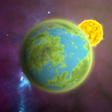
Used My Pocket Galaxy - 3D Gravity Sandbox for Android?
Editors’ Review
My Pocket Galaxy - 3D Gravity Sandbox from PocketLabs adapts a desktop-style physics playground to Android devices, giving players a mobile sandbox for building and observing planetary systems. The app centers on hands-on experimentation with celestial bodies, procedural generation, and open-ended exploration rather than levels. Its combination of a physics-driven simulation and accessible sharing tools targets astronomy enthusiasts, students of physics, and casual players who enjoy creative scientific play.
Top Recommended Alternative

My Pocket Galaxy is a three-dimensional space sandbox that hands control of celestial mechanics to the player. The central loop is placing bodies and letting the simulation unfold, driven by an N-body gravity engine that makes every object exert gravitational pull on others. The result is emergent orbital behaviour, where small edits to mass or position can produce long-term stability or cascading instability across a system.
What kind of simulation is this?
How do you interact with the simulation?
Interaction relies on direct placement and parameter editing: spawn procedural stars, planets, and moons, then modify mass, composition, or visual appearance before running the physics. God-mode options permit active interventions such as heating, cooling, or triggering collisions, while destruction tools include meteors and high-energy effects. The app also includes save/load and screenshot sharing so experiments can be preserved or shown to others.
What does the game look and feel like?
The environment renders in 3D with effects like gravity lensing around compact objects, and procedural generation produces varied planetary visuals. Users frequently cite high visual quality and a calming sandbox atmosphere. A step-by-step tutorial explains touch gestures and interface tools, yet some users report a slight learning curve when managing dense, multi-body systems and advanced interactions.
How long does the experience last and what keeps it fresh?
There is no fixed end state, so longevity depends on player goals and experimentation. Procedural generation ensures repeated sessions produce fresh planets, and unlockable planet types are tied to in-game cosmic events to reward exploration. The Planet Journal records environmental conditions and tracks life development, providing an ongoing narrative thread for players who treat runs as long-form scientific experiments rather than short play sessions.
Pros
- N-body gravity engine produces realistic orbital interactions
- Planet Journal records planetary conditions and life development
- Procedural generation yields varied planets for replayability
- Save and screenshot tools let players preserve and share creations
Cons
- Some users note a slight learning curve for the interface
- Open-ended design lacks structured, mission-driven progression
Bottom Line
Final position: well suited for experimenters, less so for mission players
In summary, My Pocket Galaxy is a fitting mobile sandbox for astronomy enthusiasts and students who enjoy long-form experimentation, because it models N-body gravity and supports life-tracking. Players seeking structured, mission-driven progression should consider alternatives, since the app emphasizes open-ended creation and observational play rather than staged objectives. Its availability on Android and iOS makes experimental physics accessible on handheld devices, and unlockable content rewards patient exploration.
Used My Pocket Galaxy - 3D Gravity Sandbox for Android?