Used Audacity for Windows?
Editors’ Review
Audacity records live media input, imports sound files, arranges clips across timelines, and writes projects into a single session file for later editing. Multi-track editing places separate recordings on individual lanes, while the Waveform view displays peaks and transients as visual references during clip movement and cut placement.
Top Recommended Alternative

Audacity’s Recording controls capture microphones, interfaces, or system sources directly into armed tracks. Non-destructive editing keeps the original audio data beneath clip boundaries while handles resizable sections. Project storage collects tracks, metadata, labels, and effect states within a single session structure, preserving edit positions, fades, and timeline relationships between clips.
Audacity’s Spectral selection isolates frequency ranges directly from the waveform display, allowing noise bands, resonances, or tonal artifacts to be targeted without affecting adjacent content. Noise Reduction samples a noise profile, builds frequency references, and subtracts matching content during processing. Label Tracks store markers, timestamps, and text references across sessions. However, the interface still uses separate effect dialogs instead of a consolidated inspector, which interrupts continuous parameter adjustments between passes.
Precision frequency control
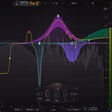
Audio transformation expands through Compressor, Limiter, and Equalization modules that rewrite amplitude curves, frequency balance, and peak behavior after preview playback. Time Stretching alters clip duration while maintaining pitch relationships, and Pitch Shift changes musical key without rewriting tempo markers. Processing remains clip or region-based for many effects, so parameter automation across long timelines is still limited compared with console-style envelope systems.
Recent builds also include OpenVINO AI Effects, local speech analysis tools, and cloud-linked export options through audio.com integration. Whisper transcription converts spoken content into text by running local speech models, while Stem Separation splits vocals and accompaniment into isolated tracks. Some AI functions require separate model downloads or module activation before appearing in the effect browser, adding setup steps beyond the standard install flow.
Pros
- Open-source editing platform
- Multi-track waveform timeline
- Local AI transcription tools
- Spectral repair controls
Cons
- Separate effect dialog windows
- Limited timeline parameter automation
- AI modules need manual activation
Bottom Line
Spectral power
Audacity combines recording, multi-track editing, spectral cleanup, dynamic processing, pitch and tempo manipulation, AI-assisted transcription, stem separation, and cloud-linked project transfer inside one audio production environment. Project files retain edit states, labels, and effect placements across sessions. At the same time, effect dialogs remain detached from the main workspace, timeline automation stays limited for long-form parameter changes, and certain AI modules require additional downloads or activation before use.
What’s new in version 3.7.7
- Fixed database compacting not working properly sometimes
- Improved startup speed on systems with many audio devices