CNET Editors' note: This is a very large (336MB) file and may take several hours to download via dial-up modem.
Publisher's Description
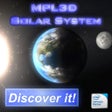
From MPL3D:
Based on real data, explore more than 10.000 real extrasolar objects. Dynamic representation of stars: Main types, variable stars, multiple star systems. Solar System and +120 known extrasolar worlds. All extrasolar planets are different, based on the scientific data available for them, with appearance changes and atmospheric effects. +250 binary star systems, including systems with mass-transfer stars. Most famous nebulae, star clusters and galaxies. More features, like the black hole at the center of our galaxy. Friendly camera control. Watch current positions or travel in time.
What's new in this version: Version 1.2 features real star colours, new star surface shader, 3 new planetary shaders, surface star oscillation, 3d star sound, revised star flares, logarithmic brightness, and brightness compensation.
More Popular Science Software downloads
- Google Earth
10,881 downloads
- I-Doser Free
3,455 downloads
- ACD/ChemSketch Freeware
905 downloads
- Stellarium
699 downloads
- PyMOL
461 downloads
-
All versions:
5.0 starsout of 3 votes
-
Current version:
0 stars Be the first to review this product -
My rating:
Write review
Results 1-3 of 3
-
"A great simulation of our solar system and beyond."
Version: MPL3D Solar System 1.1
Pros
Very accurate astronomy software built with nice modeling of the solar system as well as the local stars, their planets etc. Includes nice nebulae that you can explore and even Sagittarius A* is included. You can view galaxies externally.
Cons
The graphics need a little more work in order to take advantage of what current graphics cards have to offer.
Summary
I like the fact that all the planets, moons etc have their orbits and move around the sun in real time reflecting past, present and future times that can be set in to the software. You can speed up and slow down time as well. Like the fact that you can search and filter results based on the different classes of stars and planets - the local selector allows you to visit any body that any other star system contains. There are many local star systems you can explore up to a certain radius from earth. All the nebulae are included and you can even visit many globular clusters that are both within the disk of the Milky Way and those that are above and below that disk. It's a nice surprise taking a visit to the super massive black hole at the center of the Milky Way and if you wait you will see a star get caught by this object, ripped apart and then swallowed with an explosion of matter that attempts to imitate black hole polar jets quite well. It's so fun to see all the different stars, along with their surfaces that change and the sunspots coming and going as they move around. You will see flares in a star's corona and you can also see the photon streams ( that you can turn off ) indicating magnetic field properties. Their are stars that such matter off other stars, stars with proto-planetary discs around, stars in binary and above configurations. There really is a lot to see in this package and a statistics summary on exiting keeps tracks of the percentage of the simulation seen and how many stars, planets etc you have visited. You can also back this statistics file up ( manually ) so that if you have to re-install, you can restore these back in to the software. There are a few local galaxies you can view from a distance, including our own and I hope they expand on this with including galaxies from our local super cluster ( even beyond ). This software has a lot of potential for expansion based on what I've seen thus far in version 1.1. To sum up: great product - lot's of features for the price and the graphics do the job with illustrating events however, they do need bringing up to date in order to compete with some of the other applications available.
-
"Just...huge!"
Version: MPL3D Solar System 1.1
Pros
extremely comprehensive database of the solar system (and beyond).
All of the bodies are where they should be accoring to the time you specify.
Great learning tool and visually stunning which helps to keep my kids focused.Cons
Version 1 had quite a difficult interface, but this is no longer a con in 1.1
Summary
I installed this for my own children, and to see if it would be useful to schools. I've learnt a lot myself in the process. I'm not a teacher (I'm a school governor) and although I can't comment on it's educational suitability, it will definitely keep them focused on the topic. All of the scientific data (some of which is beyond me!) is displayed on-screen. The visuals are just great, far better than coloured globes hanging in space!
Version 1 was alittle bit tough to use. Whenever I tried to find a particular body, I was literally lost in space. 1.1 has fixed all of this so now it's much easier to use as well as looking good.
The download is big, but I guess it needs to be to hold all of known space :) -
"Worth the price. Good space simulation"
Version: MPL3D Solar System 1.1
Pros
Easy to use. Many planets, stars, nebulae, etc.
Hypnotic space views.
You can find a star or other celestial body and travel to it.
Add Your Review
Submit your reply
E-mail this review
Report offensive content
Previous Versions: